
If you're serving on a condo or HOA board, or considering hiring a management company for the first time, you've probably wondered exactly what you're paying for. The short answer is that a community association management company handles the day-to-day operations of your association so the board can focus on governance decisions. But "day-to-day operations" can mean very different things depending on how the firm is structured and what's written into your contract. What does an HOA management company do well? It runs the operational side of your community quietly and consistently. What separates a well-run firm from one that's just collecting a fee usually comes down to delivery model and scope discipline. This guide breaks down both.
Core Responsibilities of a Management Company
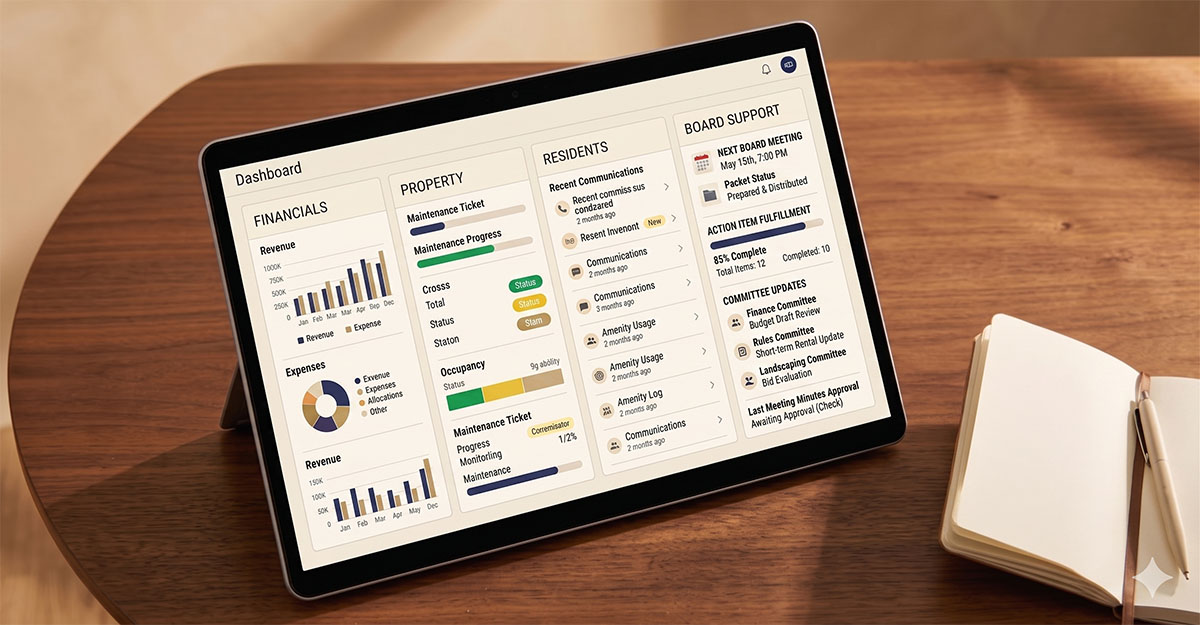
At a minimum, a community association management company should handle four categories of work for your board. The quality of how each is delivered varies dramatically across firms, and that variation is usually the difference between a board that feels well-supported and a board that feels like it's still doing most of the job itself.
Financial management is the foundation. This includes assessment collection, accounts payable and receivable, monthly financial reporting, budget preparation, reserve fund tracking, and tax preparation support (compiling records for CPA filing of Form 1120-H or the appropriate return). The quality range here is wide. At the lower end of the industry, a community manager handles bookkeeping in a spreadsheet between everything else they\'re doing. Financials arrive late, reconciliations lag, and complex transactions go unreviewed. At the higher end, a dedicated accounting team with CPA oversight performs daily reconciliation, applies a risk-graded review process, and delivers monthly reports on a predictable schedule. The difference shows up in how confident your board feels signing the annual budget.
Property and maintenance oversight covers building inspections, vendor coordination, work orders, capital project management, insurance coordination, and reserve study oversight. In most firms, the community manager handles all of this alongside everything else, which means inspections become checklists rather than informed assessments. In firms with a dedicated property services team, especially one led by someone with construction management or project oversight experience, capital projects get scoped properly, vendors get vetted, and the building gets stewarded as a long-term asset rather than a list of work orders. For Florida coastal condominiums in particular, this is where SIRS coordination, hurricane preparation, and capital project sequencing either get done well or don\'t.
Homeowner communications include inbound calls and emails, portal support, payment inquiries, violation notices, and resale or rental coordination. Responsiveness is the most common complaint boards have about their management company, and the reason is almost always structural. When the community manager is also the single point of contact for every homeowner question, hours of their day get consumed by routine inquiries that never reach the board. Firms that separate homeowner-facing work into a dedicated team, or use AI-assisted systems to handle routine requests, solve this at the system level rather than asking the manager to "be more responsive."
Board governance support is the manager\'s primary relationship with the board: meeting agendas, minutes, action item tracking, board correspondence, legislative updates, and coordination with the association attorney and insurance agent. When a manager is buried in property issues and homeowner calls, governance support is what gets deprioritized. That\'s where boards feel most acutely that their company isn\'t carrying its weight.
Those are the core HOA management company responsibilities every board should expect. The question worth asking is whether your current firm delivers each one at the level your community actually needs.
What the Board Is Still Responsible For
A management company works for the board. It doesn't replace the board. Even with a strong management partner in place, certain responsibilities stay with the directors who signed up to govern.
Policy and governance decisions belong to the board. The board sets the rules, approves the budget, sets assessment levels, and makes every governance decision that requires fiduciary judgment. The management company advises, recommends, and executes, but the ultimate responsibility remains with the directors.
Vendor selection and contract approval sit with the board, even when the management company does the heavy lifting. The management company should solicit bids, vet vendors for licensing and insurance compliance, and present qualified recommendations. The board approves the contract, especially for any expenditure above a defined threshold.
Community direction is uniquely board territory. Long-term capital planning priorities, reserve funding strategy, aesthetic standards, and rule changes are all decisions informed by management company guidance but made by the board.
This boundary matters because scope confusion is one of the top reasons boards become dissatisfied with their management company. When a board expects the company to make decisions that are properly the board's, or when the company has been positioned as "all-inclusive" without scope discipline, friction builds quickly. The healthy framing is straightforward: the management company handles operations; the board handles governance. When expectations and scope are aligned in the contract from day one, both sides know exactly where the line sits.
The Difference Between a Single-Manager Model and a Departmentalized One
Most management companies assign a single community manager to handle everything for your association: finances, property issues, homeowner calls, board meetings, vendor management, and capital project oversight. That's the industry default. It's also why boards experience the same frustrations no matter which firm they hire: slow responses, dropped balls, missed details, and a manager who quietly burns out and eventually leaves.
The alternative is a departmentalized model, a firm structured so that specialized teams handle each category of work.
Single-Manager Model One manager handles finances, property, homeowner communications, and governance. Quality is bounded by what one person can carry. High burnout risk and frequent turnover. When the manager leaves, institutional knowledge leaves with them.
Departmentalized Model Specialized teams handle accounting, property services, resident communications, and governance. Each function is delivered by people whose entire job is that function. Lower burnout, longer tenure, more continuity. When a manager leaves, the board still has its operational infrastructure intact.
Financial management lives with an accounting department, ideally with CPA oversight and a defined review process. Property services lives with a team led by someone with construction or project management experience, dedicated to inspections, vendor coordination, and capital projects. Homeowner-facing communications live with a dedicated coordinator team, often supported by AI-assisted systems that resolve routine requests instantly. And the community manager focuses exclusively on board governance: meetings, agendas, action items, and the board relationship itself.
In this model, the manager-to-community ratio can actually be higher, because the manager isn't carrying ancillary work that belongs to other departments. More importantly, when a manager leaves (and they will, eventually, because turnover is endemic to this industry), the board doesn't lose its entire operational infrastructure. Institutional knowledge lives in the departments and the systems, not in one person's head.
This applies equally to condos and HOAs. What does a management company do for a condo association that the single-manager model struggles to deliver? It stewards complex buildings with the capital project expertise, insurance coordination, and SIRS compliance support that no overloaded generalist can match. When you're evaluating management companies, whether for a condo association or an HOA, the most useful question isn't "what do you do?" It's "how are you structured to do it?"
How to Evaluate Your Current Management Company
If you're already working with a management company, here are six questions your board should be able to answer without much effort. These aren't an audit. They're a gut check.
- Do you receive monthly financials with clear, current numbers, or are you waiting months for reports?
- When you call or email, who responds: your manager, a dedicated team, or no one?
- Is your reserve study current and funded according to a defined plan?
- Does your manager attend board meetings prepared, with an agenda, action items, and follow-ups, or do meetings feel disorganized?
- If your manager left tomorrow, would your association lose its entire operational infrastructure?
- Do you know exactly what's included in your management fee, and what services cost extra?
If any of these give you pause, it may be time to request proposals from other firms. You don't have to decide today. But you should know what to look for when you do. The Community Associations Institute's resources for homeowner leaders offers additional guidance on evaluating community association management partners, and the Foundation for Community Association Research publishes industry data and benchmarks that can help your board understand how well-run associations operate nationally.
Frequently Asked Questions
What does an HOA management company do?
An HOA management company handles the day-to-day operations of your association: financial management, property and maintenance oversight, homeowner communications, and board governance support. This work frees the board to focus on policy decisions. The exact scope of services varies by contract and by how the company is structured. Boards should review their management agreement carefully so they understand exactly which responsibilities the company has taken on and which still rest with the board.
What does a management company do for a condo association?
A management company provides the same core services for a condo association as it does for an HOA, plus responsibilities specific to condominiums: master insurance policy coordination, structural integrity reserve studies (SIRS) every 10 years for buildings three habitable stories or higher, building envelope maintenance, and capital project oversight for shared structural elements. Condo management is typically more complex than HOA management because the association owns and maintains the building itself, not just common areas. The right management partner brings capital project expertise and a financial process equipped for the higher reserve and capital demands that come with aging coastal buildings.
What's the difference between an HOA board and a management company?
The board makes governance decisions: setting budgets, approving expenditures, establishing rules, and fulfilling fiduciary duties to the association. The management company executes those decisions and handles operations. The board is the employer; the management company is the service provider. The management company advises and recommends; the board decides. Healthy boards treat the management company as a partner that brings operational expertise to the table while preserving every governance decision for themselves.
How do I know if my management company is doing a good job?
Evaluate against three basics first: are financials delivered monthly, on time, and clearly formatted? Are calls and emails returned within a reasonable timeframe? Does your manager arrive at meetings prepared, with an agenda and follow-through? If those baseline expectations aren't being met consistently, the rest doesn't matter. Once those are in place, look at structural factors: whether the company has specialized teams or relies on a single manager for everything, and whether the scope of services is documented clearly in your contract. A company that delivers the basics reliably and has the structure to handle complexity is the one worth keeping.
What Boards Should Actually Expect
A management company should handle four categories of work for your board: financial management, property oversight, homeowner communications, and governance support. How well any given firm delivers depends on how it's structured, who's actually doing each task, and what's written into your contract. The best management partnerships look the same on the outside: specialized teams, clear scope documentation, and a service model designed for continuity rather than personality. The board's job is to govern. The management company's job is to make governing easier.